Key Takeways:
- Frequent reimbursements can make business expense management slower and harder to scale.
- Manual reimbursement claims increase finance workload through repeated checks and approvals.
- Asking employees to fund business expenses can create financial stress and reduce trust.
- Expense cards give finance teams greater visibility and control over employee spending.
- Company-funded cards reduce the need for employees to pay business costs upfront.
- Reimbursements suit occasional costs, while expense cards work better for regular spending.
Are Reimbursements Making Business Expense Management More Complicated?
Many businesses rely on reimbursement processes to manage operational expenses, whether it’s paying for a client lunch, covering staff travel, or buying office supplies.
On the surface, it seems straightforward and harmless: employees pay upfront, and the company pays them back. But what appears to be a convenient system is, in fact, quietly draining resources, undermining morale, and stalling operational efficiency.
As the number of claims grows, reimbursement can also make business expense management increasingly complicated. Finance teams must track receipts, approvals and repayments, while employees are responsible for funding company purchases from their own pockets.
This raises an important question: is reimbursement really the most efficient way to manage business expenses?
Reimbursements are inherently inefficient
While it may seem like a faster way to pay for expenses, the reality is anything but.
Reimbursement claims require employees to jump through multiple hoops: collecting receipts, filling in forms, chasing managerial approval, and waiting for finance to reconcile transactions.
A single error, like a missing receipt or an incorrect form, can derail the entire process. And even after final approval, reimbursements are often only processed in the next payment cycle. That leaves employees financially exposed, sometimes for weeks.
This kind of administrative lag isn’t just inefficient; it’s antiquated.
The problem can become more pronounced as transaction volumes increase. A manual expense management process that works for occasional purchases may become increasingly difficult to administer when multiple employees regularly submit claims.
For finance teams, this can mean more time spent on expense tracking, checking documentation, obtaining approvals and reconciling transactions.

The Hidden Administrative Cost of Business Expenses
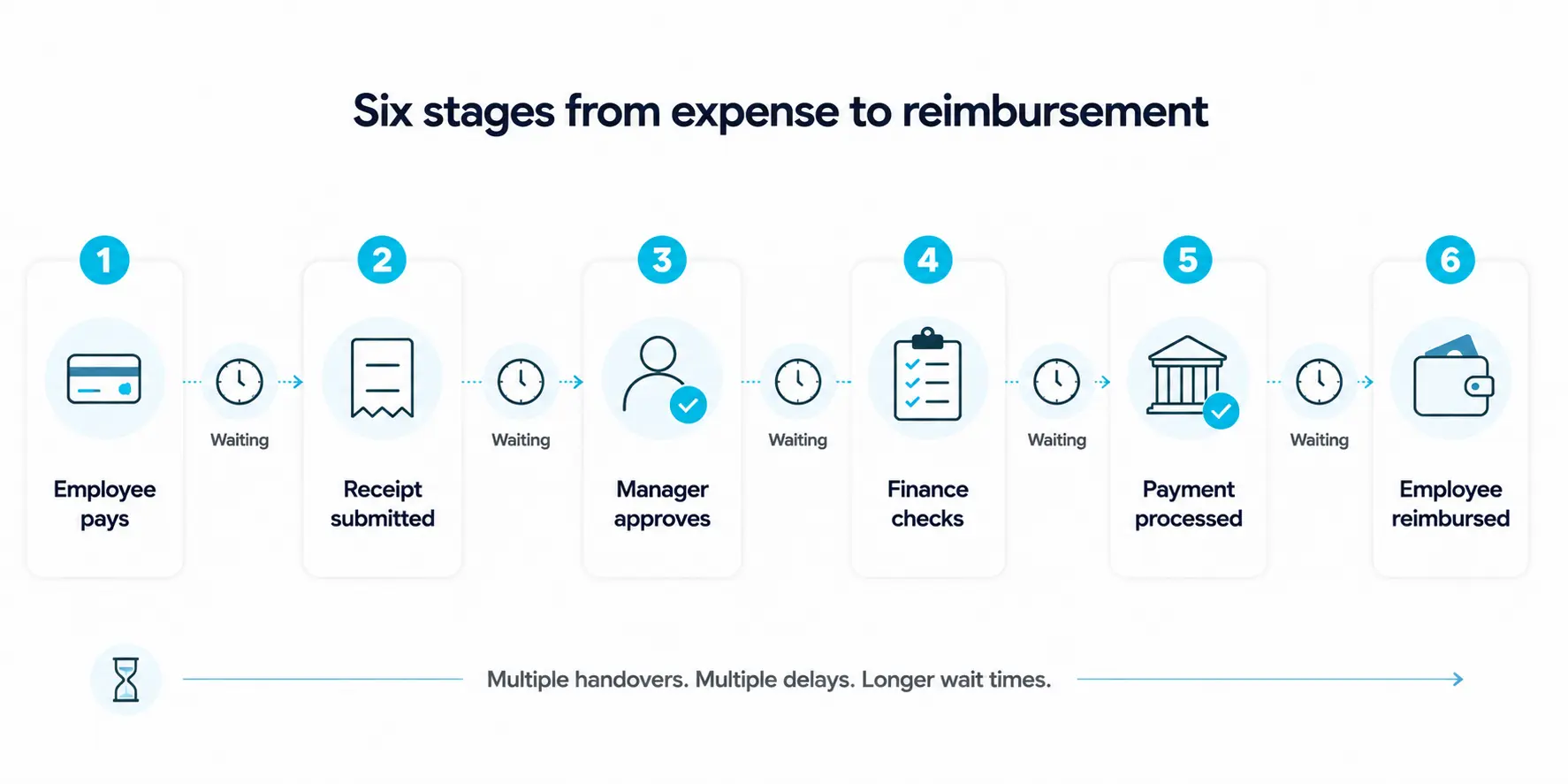
The real cost of reimbursement goes beyond the amount ultimately paid back to the employee. Each claim can involve several internal steps:
Employee pays → Receipt submitted → Manager approves → Finance checks → Payment processed → Employee reimbursed
Every additional touchpoint requires time. When multiplied across departments and hundreds of business expenses, seemingly small administrative tasks can create a significant workload.
An effective business expense management strategy should therefore consider not only what the company spends but also how much internal effort is required to process that spending.
Reimbursements undermine employee trust and financial well-being
Here’s where the true cost comes in.
Most often, employees who cover different types of expenses out-of-pocket are not business owners or executives; they’re support staff, junior employees, or field workers. For these individuals, fronting money can pose a significant financial burden. A delayed reimbursement could mean missing a bill payment or incurring interest on credit used to cover the gap, adding to the financial stress of your employees.
A survey conducted by World Wide Worx, commissioned by TymeBank, revealed that 76% still find themselves out of money before the month ends.
A study showed that 57% of South Africans stated that their mental wellbeing was impacted most severely by financial stress.
The emotional toll is just as damaging. Having to repeatedly follow up on their own money can feel demeaning and demoralising. Over time, this erodes trust, fosters resentment, and contributes to workplace dissatisfaction, especially when the system seems to favour senior staff with access to company credit cards.
Reducing the need for employees to personally fund legitimate business expenses can therefore benefit more than administrative efficiency. Providing an appropriate company-funded spending method can also improve cash flow and reduce the period during which employees are personally out of pocket.
Reloadable debit cards as a smarter alternative
Forward-thinking businesses are now shifting to reloadable debit cards, a more efficient, equitable, and scalable solution. These cards allow companies to preload expense allowances directly to employees, eliminating the need for them to spend their own money in the first place.
The benefits go far beyond convenience. With real-time transaction tracking, downloadable reports, and spending controls, reloadable cards offer superior compliance and control. Finance teams can instantly monitor where funds are going, ensuring every cent is spent in line with company policy.
Additionally, having pre-set budgets on each card encourages smarter spending habits and makes expense forecasting easier and more accurate. You’re not just digitising the process, you’re building a proactive expense culture.
For organisations managing frequent employee spending, CashCentral+ provides reloadable payment cards that allow businesses to load approved funds upfront, reducing the need for employee reimbursements.
Employee Reimbursements vs Business Expense Cards
The right method depends on how frequently employees spend and how much control the organisation requires.
| Consideration | Employee Reimbursement | Business Expense Cards |
| Employee pays upfront | Usually | No |
| Employee out-of-pocket | Yes, until reimbursed | Reduced |
| Spending visibility | Usually after purchase | Real-time |
| Expense tracking | Often involves manual steps | Can support centralised management |
| Budget control | Reactive | Funds can be allocated beforehand |
Business expense cards and employee expense cards can be particularly useful where staff regularly make approved purchases and the organisation wants greater visibility over spending.
When Should Businesses Use Reimbursements or Employee Expense Cards?
Reimbursement is not necessarily unsuitable for every expense. It can remain practical for genuinely occasional or unexpected purchases where establishing another payment method would add unnecessary complexity.
However, the equation changes when employees repeatedly make purchases for travel, supplies, operational requirements or other predictable business expenses.
In these situations, employee expense cards may help reduce repetitive reimbursement administration while giving employees access to company-funded money when they need it.
Businesses should consider:
- How frequently employees make purchases
- How many reimbursement claims finance processes
- How long employees typically wait for repayment
- What spending controls are required
- Whether current expense tracking provides sufficient visibility
- How much finance and management time the existing process consumes
This creates a more useful decision framework than assuming every employee purchase should automatically enter the reimbursement process.
Reimagining Company Spending for the Modern Age
In a time when businesses are striving to be more people-centric and operationally lean, clinging to outdated reimbursement models is counterproductive. The shift toward smarter expense solutions like reloadable debit cards isn’t just about modernisation, it’s about recognising that how your company handles money says a lot about how it values its people.
So ask yourself: Is your current expense system supporting your business strategy or silently sabotaging it?
The future of finance isn’t about managing the fallout. It’s about eliminating the friction. And that future is already here.
Reimbursements aren’t the only underestimated cost. Using cash for petty expenses could be quietly draining your bottom line.
Explore the blog on The Hidden Costs of Petty Cash for Businesses.
Take Control of Business Expenses
Reimbursements may be familiar, but they are not always the most efficient way to manage business expenses. A more proactive approach to business expense management can reduce administration, improve visibility and help employees avoid paying company costs from their own pockets. With PayCentral, businesses can simplify how approved funds are managed while maintaining greater control over company spending.
Ready to reduce reimbursement admin and improve control over business expenses? Explore CashCentral+, PayCentral’s business expense management card solution.
Frequently Asked Questions
What are the disadvantages of reimbursing employee business expenses?
Employee reimbursement can require staff to fund business expenses personally before submitting receipts, obtaining approval and waiting for repayment. It can also create additional administration for finance teams.
How can businesses improve expense tracking?
Businesses can improve expense tracking by establishing clear spending policies, centralising transaction information and using payment methods that provide greater visibility over employee expenditure.
What is an employee expense card?
An employee expense card is a company-provided card employees can use for approved work-related purchases, reducing the need to use personal money and subsequently submit a reimbursement claim.
Are business expense cards an alternative to employee reimbursements?
Yes. Business expense cards can provide employees with access to company funds before approved purchases are made, making them particularly useful for regular or predictable expenditure.
How can a reloadable debit card help manage business expenses?
A reloadable debit card can allow a business to allocate funds to employees for approved expenditure while providing greater visibility and control over how company money is spent.